
Antimicrobial photodynamic therapy (aPDT) has proven effective in combating multidrug-resistant bacterial infections by activating photosensitizers to generate cytotoxic reactive oxygen species. Enhancing the efficiency of aPDT through the fluorescence resonance energy transfer (FRET) effect is a promising strategy.
In a study published in Chemical Engineering Journal, the research group led by Prof. CHEN Zhuo from Fujian Institute of Research on the Structure of Matter (FJIRSM) of the Chinese Academy of Sciences innovated bacterial-mediated FRET technique to synergistically boost antimicrobial photodynamic therapy outcomes with photosensitizers. Their method harnesses bacteria as carriers, effectively leveraging the unique properties of these microorganisms to further enhance therapeutic efficacy of aPDT.
The researchers designed a dual-photosensitizer system in which an aggregation-induced emission (AIE) photosensitizer serves as the energy donor, and an aggregation-caused quenching (ACQ) photosensitizer acts as the acceptor. The spectral overlap between the emission spectrum of the AIE photosensitizer and the absorption spectrum of the ACQ photosensitizer enables efficient FRET.
By attaching both photosensitizers to the same bacterial membrane-targeting group, the researchers achieved concurrent accumulation of the photosensitizers on the bacterial membrane. Upon exposure to light, the photosensitizers exhibited remarkable synergistic antibacterial activity against Escherichia coli and drug-resistant Acinetobacter baumannii.
Furthermore, the researchers demonstrated the therapeutic potential and biocompatibility of this novel aPDT strategy in a mouse wound infection model caused by Escherichia coli. The results were particularly encouraging, suggesting a potential breakthrough in the treatment of multidrug-resistant bacterial infections.
This study offers a promising approach to address the growing challenge of multidrug-resistant bacterial infections.
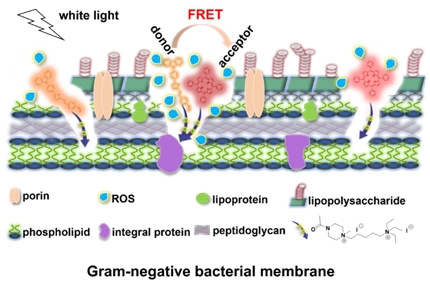
The highly efficient energy transfer mechanism is represented by the FRET effect displayed by two photosensitizers sharing the same bacterial membrane targeting group within Gram-negative bacteria. (Image by Prof. CHEN Zhuo's group)
CHEN Zhuo
Fujian Institute of Research on the Structure of Matter
E-mail: zchen@fjirsm.ac.cn

Researchers from Institute of Biophysics (IBP) of Chinese Academy of Sciences based on a co-expression system presented a generic method for site-specific incorporation of a single donor-acceptor dye pair into any desired position in a dimeric protein.
Photodynamic therapy (PDT) is an emerging therapeutic modality for malignant cancers. Recently, researchers at Fujian Institute of Research on the Structure of Matter of Chinese Academy of Sciences reported the controllable photodynamic effects by using a type of smart ph...

86-10-68597521 (day)
86-10-68597289 (night)

52 Sanlihe Rd., Xicheng District,
Beijing, China (100864)
Copyright © 2002 - Chinese Academy of Sciences


